

One conversation I seem to have regularly when visiting our clients is about leadership.
I will be talking with a General Manager or senior manager and somewhere in the conversation I will hear something along the lines of:
“Our leaders just don’t know how to lead.”
Usually, they are not saying their leaders are bad at their jobs. In fact, many of them are very good at the operational side of what they do. They know the business, understand the procedures, can solve problems and are often the people everyone turns to when something needs to get done.
The challenge comes when they need to lead people.
How do they approach a staff member who is not performing? How do they give feedback without putting someone immediately on the defensive? How do they motivate different personalities? How do they deal with conflict? How do they have a difficult conversation and still maintain a positive working relationship?
These are very different skills, and being promoted into a leadership position does not automatically give someone the ability to do them.
Being a Great Operator Does Not Automatically Make You a Great Leader
One of the common mistakes businesses make is promoting their best-performing employee into a leadership position and expecting them to know how to lead.
They may have been promoted because they are reliable, experienced, knowledgeable and technically very good at their job. All great reasons to recognise someone.
But leadership requires another skill set.
An effective leader needs to be able to:
- Communicate clearly and confidently
- Understand what motivates different people
- Provide constructive feedback
- Manage difficult conversations
- Recognise when their approach is not working
- Stay composed when situations become challenging
- Build trust and positive working relationships
- Influence behaviour rather than simply tell people what to do
These skills can be learnt and developed, but first we need to recognise that our leaders may need some help to build them.
Leadership is About Influence
There is a big difference between having authority and having influence.
A job title may give someone the authority to tell another person what to do. It does not necessarily mean that person will respect them, trust them or want to follow their direction.
Effective leaders understand how to influence people. That starts with understanding that everyone is different.
One staff member may respond well to very direct feedback. Another may shut down completely with the same approach. One person may need encouragement and reassurance, while another wants you to simply tell them what needs to change.
Good leadership is not about treating everybody exactly the same. It is about understanding your people well enough to know how to get the best from them.
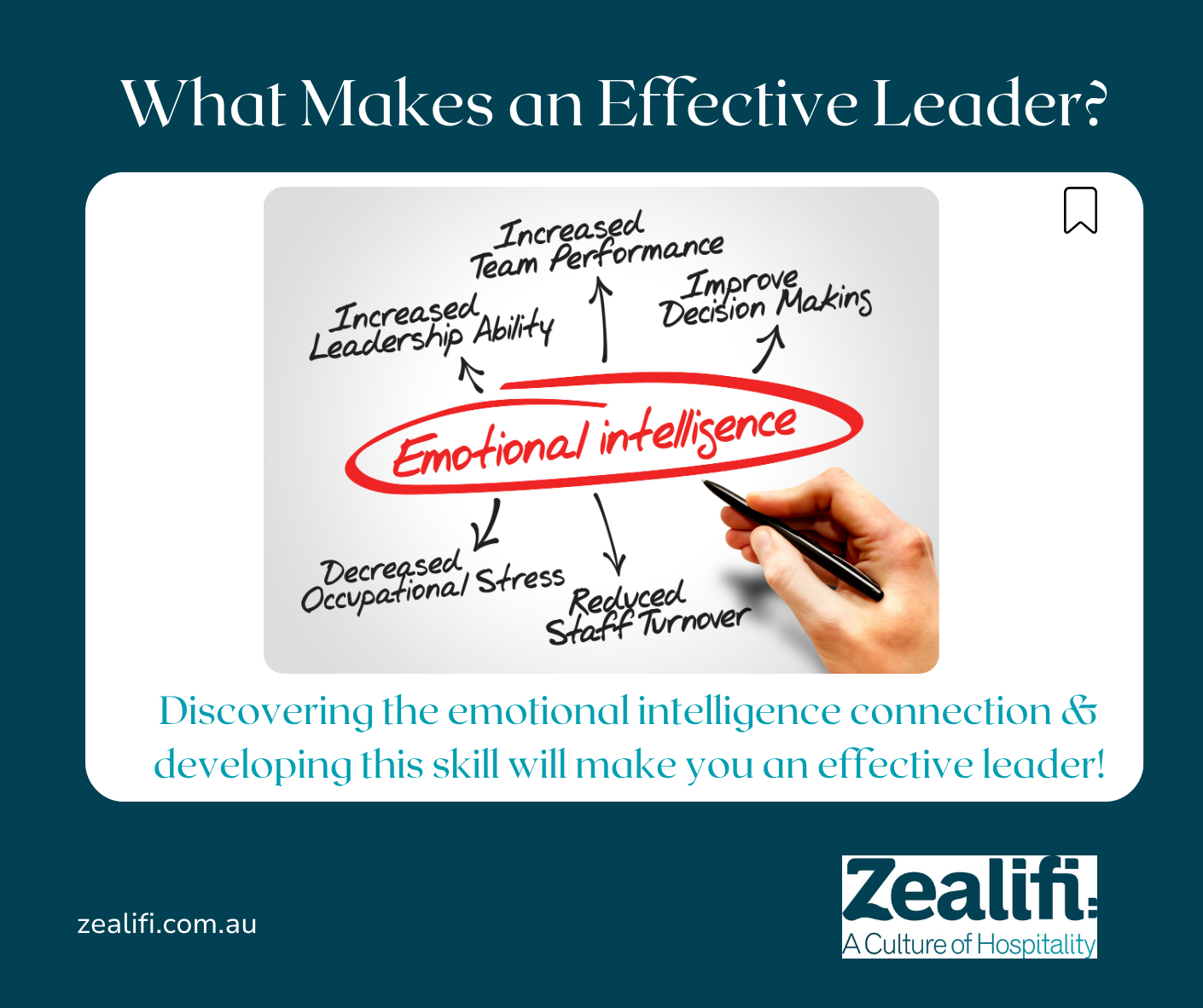
And this is where Emotional Intelligence becomes particularly important.
The Emotional Intelligence Connection
Emotional Intelligence is not about being “soft” or avoiding difficult conversations.
Quite the opposite.
It gives leaders the skills to handle those conversations more effectively. An emotionally intelligent leader develops greater awareness of their own emotions, reactions and communication style, while also becoming better at recognising what may be happening for the other person.
Think about a common workplace situation.
A staff member has made the same mistake several times and the leader is frustrated. They approach the employee while they are still annoyed, their tone reflects that frustration, and the employee immediately becomes defensive.
The conversation quickly becomes about how something was said rather than the actual performance issue that needed to be addressed.
Nothing gets resolved.
Emotional Intelligence helps a leader recognise their own frustration, regulate their response and choose an approach that gives the conversation a better chance of achieving the desired outcome.
The performance issue still needs to be addressed. The difference is how the leader addresses it.
Self-Awareness is a Leadership Skill
One of the most important questions a leader can ask themselves is:
“How does my behaviour affect the people around me?”
Leaders set the tone, whether they realise it or not.
If a leader becomes stressed and reactive whenever things go wrong, that behaviour can quickly flow through the team. If they communicate poorly, avoid difficult conversations or only speak to staff when something has gone wrong, that also shapes workplace culture.
Self-aware leaders recognise their own strengths, weaknesses, triggers and communication habits.
Instead of automatically thinking, “Why won’t this employee listen to me?”, they may start asking, “Is there a different way I could approach this person?”
That small shift in thinking can make a significant difference.
Learn to Listen, Not Just Talk
Leadership communication is not only about knowing what to say.
It is also about knowing when to listen.
Sometimes leaders are so focused on solving the problem or getting their point across that they do not stop to understand what is actually happening.
There may be a reason behind a change in performance. The employee may not understand what is expected. There may be conflict within the team. They may need additional training or support.
Listening does not mean agreeing with everything an employee says. It means gathering enough information to have a productive conversation and make a better decision.
People are also far more likely to engage in a conversation when they feel they have been heard.
Difficult Conversations Should Not Be Avoided
Another challenge I see is leaders avoiding conversations because they are uncomfortable having them. The problem is that workplace issues rarely disappear because nobody talks about them.
Poor performance continues. Frustration builds. Other staff notice the behaviour. Eventually, what could have been a relatively simple conversation becomes a much bigger issue. Effective leaders develop the confidence to address issues early, clearly and respectfully. The objective should not be to “win” the conversation. It should be to achieve an outcome.
What needs to change? Does the employee understand why? What support do they need? What happens next?
When leaders have the communication and Emotional Intelligence skills to manage these conversations effectively, they become far less daunting.
Developing Better Leaders
Businesses invest significant time and money training employees in the technical skills required to do their jobs. We need to place the same importance on developing the people skills required to lead them.
Leadership is not something people either naturally have or they do not. Like any workplace capability, it can be developed through training, practice, feedback and experience.
If you have supervisors, managers or emerging leaders who are technically capable but struggle with communication, influence, feedback or difficult conversations, developing their Emotional Intelligence is a very good place to start.
Emotional Intelligence & Effective Communication Training
At Zealifi, we have developed our Emotional Intelligence and Effective Communication for the Workplace online course for $40 inc. GST (bulk discounts for 10+ online enrolments apply) to provide practical skills that can be applied in everyday workplace situations.
The course explores the core principles of Emotional Intelligence and how they can help people recognise and manage emotions, communicate more effectively and build stronger workplace relationships.
While these skills are valuable for everyone in the workplace, they are particularly useful for leaders who need to communicate, influence and bring out the best in the people around them. Because ultimately, effective leadership is not about having all the answers.
It is about knowing how to work with people to achieve the best outcome.
Want to strengthen the Emotional Intelligence and communication skills within your team?
Explore our Emotional Intelligence and Effective Communication for the Workplace online course or contact Zealifi to discuss how we can support your leaders and team.
Ph 1300 122 287 | Email hello@zealifi.com.au
Want to know what other online courses are available for your leaders and your team, check out our full list of online courses in our course library.