

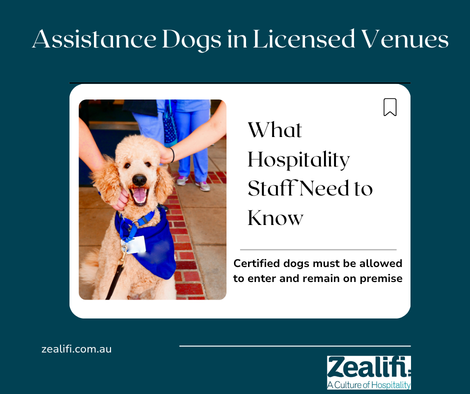
Hospitality venues are busy, fast-paced environments where customer service, safety, and legal compliance all work together. One area that venue staff should understand clearly is how to appropriately support patrons who attend with assistance dogs. Recent industry discussions have highlighted that many staff and management are still unsure about what they can and cannot do when a person enters a licensed venue with an assistance dog. Understanding the rules helps create a safer, more inclusive experience for everyone.
What Is an Assistance Dog?
Assistance dogs are highly trained working animals that support people with disability. These dogs are trained to perform specific tasks that help their handler safely access the community and maintain independence.
Examples include dogs trained to:
- Guide people with vision impairment
- Alert people with hearing impairment
- Assist with mobility support
- Detect medical conditions such as seizures or diabetes
Importantly, assistance dogs are not pets. They are working animals performing essential tasks for their handler every day.
Access Rights in Licensed Venues
Under Queensland legislation, licensed venues must allow certified assistance dogs to enter and remain on the premises with their handler. This applies to public areas of the venue, although some restricted spaces such as food preparation areas may still be excluded.
Venue staff should understand that:
- Assistance dogs must be allowed entry
- Handlers should not be separated from their dog
- Additional fees or charges cannot be applied
- “No pets” policies do not override assistance dog access rights
Failure to comply with these obligations could result in penalties for both staff/management and the venue itself.
What Can Staff Ask?
This is often where confusion occurs. Staff may politely ask to sight identification that confirms the dog is a certified assistance dog. Assistance dogs are commonly identified by:
- A blue and white badge on the harness or coat
- A handler identification card
However, staff should remember:
- Not all disabilities are visible
- Lack of visible identification does not automatically justify refusal of entry
To find out more information check out the FAQs for Businesses from Guide, Hearing and Assistance Dogs.
Practical Do’s and Don’ts for Hospitality Staff
Creating a positive experience is often about simple interactions and awareness.
Do:
- Speak directly to the person, not the dog
- Understand the dog is highly trained and working
- Educate other patrons if needed
- Allow the dog to remain with the handler
- Treat the interaction as part of normal customer service
Don’t:
- Touch or distract the dog without permission
- Make noises or attempt to get the dog’s attention
- Feed the dog
- Give the dog commands
- Ask personal questions about the person’s disability
Even well-intentioned behaviour can distract an assistance dog from performing its role.
When Can Entry Be Refused?
Refusing entry should only occur in limited situations, such as:
- The dog is behaving aggressively or uncontrollably
- There is a genuine health or safety risk
- The reason for refusal is unrelated to the assistance dog itself
For example, standard venue rules around intoxication, unsafe behaviour, or closing times still apply equally to all patrons.
Why This Matters for Hospitality Venues
Hospitality businesses are increasingly focused on creating safe, welcoming, and inclusive environments for all customers. Understanding assistance dog obligations is not only about legal compliance, but also about professionalism and customer service.
Well-trained staff can:
- Reduce the risk of complaints or discrimination issues
- Build a more inclusive venue culture
- Improve customer confidence and comfort
- Support positive community reputation
As industry expectations continue to evolve, venue staff who understand these responsibilities will be better prepared to provide respectful and compliant service.
At Zealifi, we continue to incorporate current industry topics and emerging compliance expectations into our hospitality training programs to help venues stay informed and confident in real-world situations. We update regularly our Links page that includes new industry engagement fact sheets ready to download, share and read.